
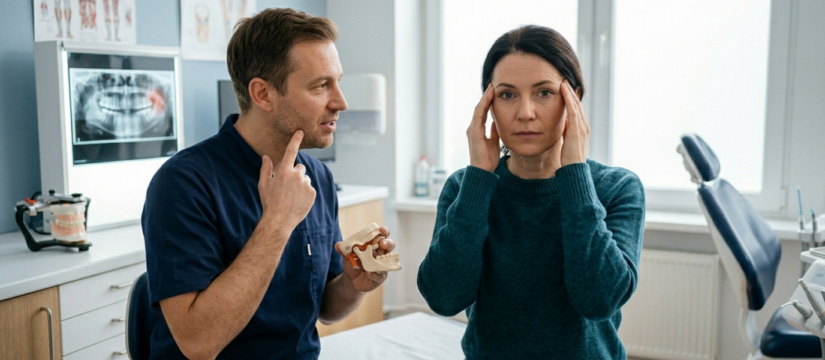
Headaches are often blamed on stress, screen time, dehydration, or lack of sleep. While these are common triggers, there’s another less obvious cause that many people overlook: your bite alignment.
A “bad bite,” also known as malocclusion, happens when your upper and lower teeth don’t align properly. What most people don’t realize is that this misalignment can quietly strain your jaw muscles and lead to recurring headaches — often without any obvious dental pain.
What Exactly Is a Bad Bite?
Your bite is how your teeth come together when you close your mouth. Ideally, the upper and lower teeth should fit together in a balanced way. When they don’t — due to crooked teeth, jaw misalignment, missing teeth, or an uneven bite — your jaw muscles have to work harder to compensate.
This imbalance doesn’t stay confined to your mouth. It affects the entire head and neck region.
The Hidden Link Between Jaw Muscles and Headaches
Your jaw is connected to a complex system of muscles called the temporomandibular joint (TMJ). This joint is responsible for movements like chewing, speaking, and clenching.
When your bite is misaligned, the TMJ is forced to function unevenly. One side may work harder than the other, leading to muscle fatigue and tension. Over time, this constant strain can trigger tension-type headaches.
These headaches often feel like:
- A dull ache around the temples
- Pressure behind the eyes
- Tightness in the jaw or neck
- Pain that worsens after chewing or talking for long periods
Because the pain shows up in the head, most people never suspect their teeth are the cause.
Teeth Grinding and Clenching Make It Worse
A bad bite often leads to unconscious habits like bruxism (teeth grinding or clenching), especially during sleep.
When the bite is not stable, the body tries to “correct” it by tightening jaw muscles. This constant pressure puts strain on the TMJ and surrounding muscles, increasing the frequency and intensity of headaches.
Many people wake up with headaches or jaw soreness without realizing they’ve been grinding their teeth all night.
Why It Often Goes Undiagnosed
One of the biggest challenges with bite-related headaches is that they mimic other common headache types, such as stress or migraine-related pain.
Since there is no visible swelling or obvious dental issue in the early stages, people tend to treat the symptoms — not the cause. Painkillers may offer temporary relief, but the underlying muscle imbalance remains unresolved.
Other Signs Your Bite May Be the Problem
Headaches are just one symptom. A bad bite often shows up in subtle ways, including:
- Clicking or popping sounds in the jaw
- Jaw stiffness or fatigue while chewing
- Uneven wear on teeth
- Facial soreness, especially in the morning
- Difficulty opening the mouth fully
If these symptoms appear along with frequent headaches, your bite alignment could be a contributing factor.
How Dental Correction Helps
The good news is that bite-related headaches are treatable once identified. Dentists can assess your bite and recommend solutions such as:
- Orthodontic treatment (braces or aligners)
- Bite adjustment or reshaping
- Night guards to prevent grinding
- TMJ therapy for muscle relaxation
These treatments aim to restore balance to the jaw, reducing muscle strain and relieving headache symptoms over time.
Not all headaches start in the head. Sometimes, they begin with something as simple as how your teeth come together.
A bad bite can silently strain your jaw muscles, trigger tension, and lead to chronic headaches without you ever realizing the connection. If headaches are frequent and unexplained, it may be worth looking beyond stress and screen time — and toward your dental alignment.
Because when your bite is balanced, your head feels the difference too.